
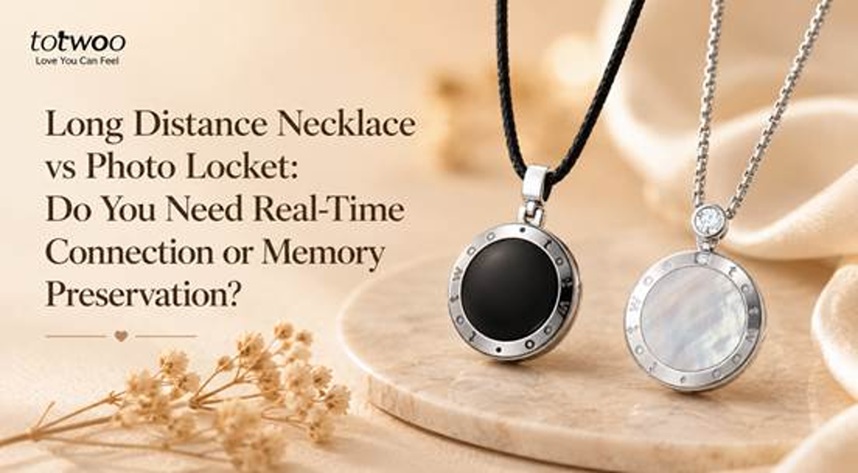
A long distance touch necklace and a photo locket should not be compared by asking which one is “more personal.” They perform different emotional jobs.
A touch necklace helps two people exchange small signals in the present. A locket preserves a person, pet, place, or moment that the wearer wants to revisit.
The more useful question is:
Do you want the gift to create real-time connection, preserve digital memories, or hold a physical photograph without any technology?
Start Here: A Simple Gift Decision Tree
Do you want to send light or vibration signals across the distance?
Choose a long distance touch necklace.
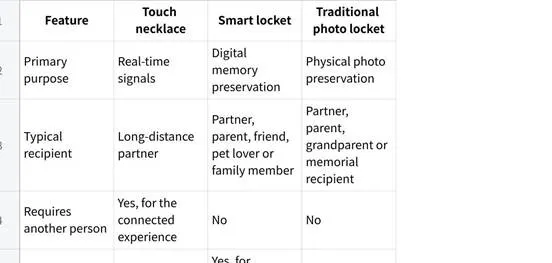
It is designed for two people who want an interactive signal during ordinary days. Both users will normally need connected jewelry, compatible phones, an app, Bluetooth, internet access, and regular charging.
Do you want to preserve several photos, a short video, or a moving memory?
Choose a smart locket.
It is designed for one person to open and revisit stored digital content. An app and charging are needed to upload and manage the memories, but the gift does not require another person to wear a paired device.
Do you want one or two printed photos with no app or charging?
Choose a traditional photo locket.
It provides the simplest memory-preservation experience. The recipient can open it at any time without using a phone, internet connection, account, or battery.
The Three Options at a Glance
Choose a Touch Necklace for Real-Time Connection
A touch necklace is best understood as a lightweight communication tool worn as jewelry.
With compatible products, one person touches the pendant and the partner’s necklace responds through light, vibration, or both.
The signal might mean:
• Good morning
• I arrived safely
• Good luck today
• You crossed my mind
• Call me when you are free
• Goodnight
The meaning is created by the couple. The necklace does not transmit a full conversation, and it should not be used for urgent or safety-related messages.
Who Is a Touch Necklace Best For?
A touch necklace may be the right choice when:
• The recipient is a romantic partner
• Both people want to participate
• They already wear necklaces
• They like light or vibration signals
• Different work schedules or time zones make spontaneous calls difficult
• Both users are comfortable with connected technology
• Both people are willing to charge and wear the jewelry regularly
Couples can compare current styles through the Totwoo long distance necklace collection.
Selected Totwoo touch-necklace models use Bluetooth 5.0 and require the Totwoo app on compatible iOS or Android phones. Both phones need Wi-Fi or mobile-data access, and the app may need permission to remain active in the background.
Current models commonly list approximately three to five days of battery life and around one hour for a full charge.
When a Touch Necklace Is the Wrong Choice
Do not choose this branch when:
• Only one person wants to use connected jewelry
• The recipient rarely wears necklaces
• Either partner dislikes installing apps
• One person frequently disables Bluetooth
• Regular charging will become inconvenient
• The recipient mainly wants to preserve photos
• The gift is intended as a private memorial rather than live interaction
Without two willing participants, a touch necklace loses much of its purpose.
Choose a Smart Locket for Digital Memory Preservation
A smart locket is designed for someone who wants more than one physical photograph but still values the familiar experience of opening a pendant.
It does not need a second person to wear a paired necklace. The recipient can open it independently whenever they want to revisit the stored content.
What Can a Smart Locket Preserve?
The current Tree of Life AI Smart Locket supports:
• Up to five photos
• One short video
• One AI-generated moving memory
• Ten included AI memory creations
• Content replacement through the Totwoo app
• Local storage on the locket after syncing
The locket can be preloaded before gifting. The buyer may receive it first and upload the memories, or use the available customization process when shipping it directly to the recipient.
Who Is a Smart Locket Best For?
A smart locket may be the strongest choice for:
• A parent carrying several family photographs
• A partner preserving memories from different relationship stages
• A pet lover keeping favorite images or a short video
• A friend moving to another city
• Someone marking a wedding, graduation or reunion
• A person who prefers opening memories intentionally rather than receiving signals
Its emotional message is not “I am touching my necklace right now.” It is “These people and moments remain available whenever you want to revisit them.”
Practical Requirements
The current Tree of Life model requires the Totwoo app and Bluetooth to upload or replace content.
Its listed specifications include:
• Up to 300 views per charge
• Approximately 8-10 days of standby time
• Magnetic USB charging
• A weight of approximately 19 grams
• A 23.6-inch chain with a 2-inch extension
• Local memory storage after synchronization
The recipient does not need another person to wear a paired product. However, someone must be comfortable setting up the app, managing the account, and charging the locket.
When a Smart Locket Is the Wrong Choice
Choose another option when:
• The recipient does not use a compatible smartphone
• They do not want an app or account
• One printed photograph tells the story adequately
• They prefer extremely lightweight jewelry
• They want live interaction rather than stored memories
• They will not remember to charge the locket
Choose a Traditional Photo Locket for Simplicity
A traditional photo locket holds a printed image inside a pendant.
It does not provide remote signals, store video, or display changing digital content. That simplicity is often its greatest advantage.
The wearer opens the locket and sees a photograph immediately. No account, Bluetooth connection, internet service, or battery stands between the person and the memory.
Who Is a Traditional Photo Locket Best For?
A traditional locket may be the most appropriate gift for:
• A parent or grandparent
• Someone who avoids connected devices
• A recipient who wants one defining photograph
• A person remembering a loved one
• Someone preserving a pet’s image
• A partner who prefers traditional jewelry
• Anyone who wants a gift that works independently for years
What to Check Before Ordering
Confirm:
• How many photos the locket holds
• Whether the seller installs the photograph
• Required image dimensions
• Whether engraving is available
• Chain length and pendant weight
• Metal and coating materials
• Whether personalized items can be returned
• How future photo replacement works
If possible, choose and install the photograph before giving the locket. This makes the emotional purpose clear as soon as the recipient opens it.
Choose According to the Moment the Gift Should Create
The easiest way to decide is to imagine how the recipient will use the gift.
During a Busy Workday
If you want to send a small signal that arrives during the day, choose a touch necklace.
During a Quiet Personal Moment
If the recipient should be able to open several photos or a video whenever they choose, select a smart locket.
Without a Phone or Setup Process
If the recipient should immediately see one treasured photograph, choose a traditional photo locket.
For a Long-Distance Romantic Relationship
Choose a touch necklace when both partners want active participation. Choose a smart or traditional locket when the gift is centered on preserving the relationship’s memories.
For a Parent or Grandparent
A traditional photo locket is usually the simplest option. A smart locket may be appropriate when the recipient is comfortable using an app and would value several family memories.
For a Pet or Memorial Gift
Choose a traditional locket for one defining image and no technological requirements. Choose a smart locket when several photographs, a short video or a moving memory would better preserve the story.
The Answer Is Interaction, Digital Memory or Simplicity
Choose a touch necklace when the gift should create real-time signals between two willing participants.
Choose a smart locket when the recipient should be able to carry several photos, a short video, or a moving memory in one pendant.
Choose a traditional photo locket when one physical photograph and a technology-free experience are enough.
None of these choices is automatically more personal. The right answer depends on the moment the gift is supposed to create: an immediate signal, a collection of digital memories, or a quiet encounter with one photograph.